
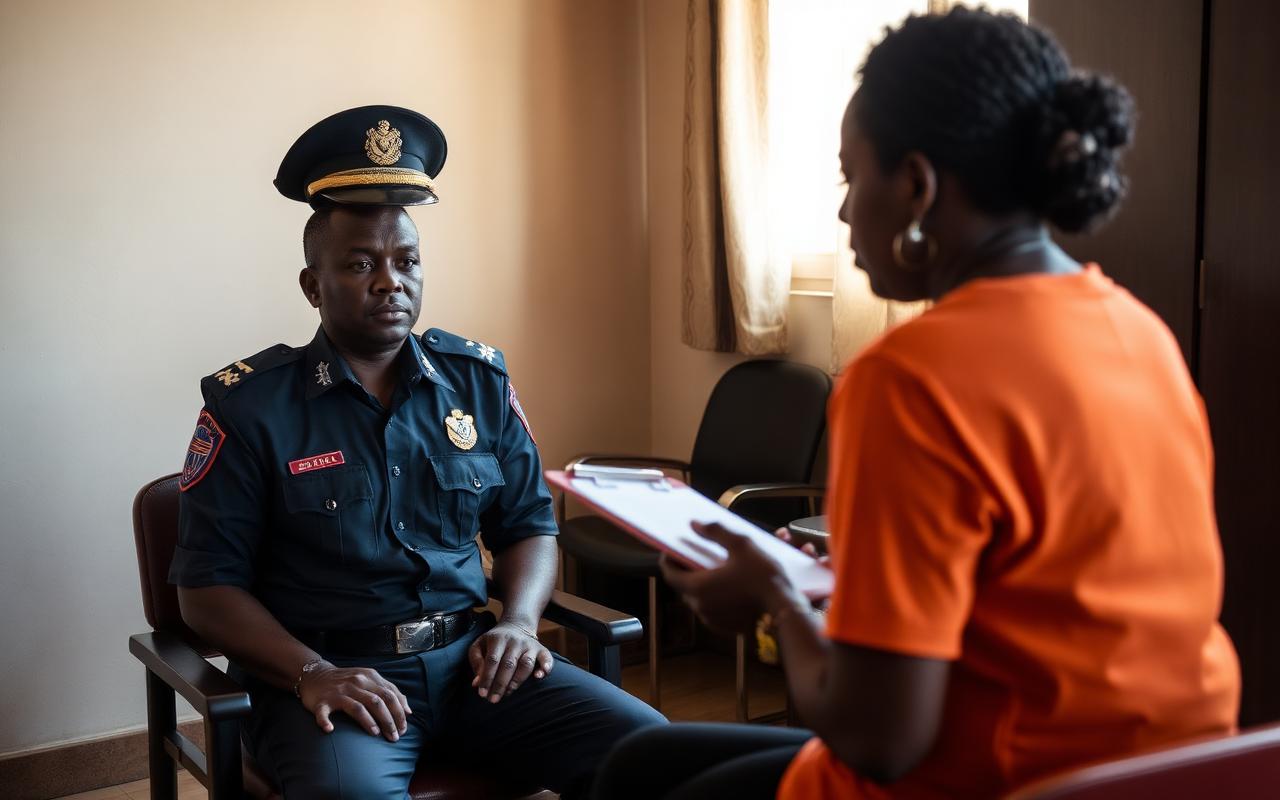
Mental Health Assessments for Security & Police
Fit-for-duty starts with a fit mind.
Confidential psychological assessments and ongoing mental health support for Uganda Police officers, UPDF personnel and private security guards — the armed men and women who carry the weight of public safety every day.
Across Uganda, more than 100,000 private security guards and tens of thousands of Uganda Police and UPDF officers carry firearms on duty — often after 12-hour shifts, on low pay, with no formal mental health screening before, during or after deployment. The cost is paid in suicides, accidental discharges, domestic violence and avoidable use-of-force incidents that scar both officers and the communities they serve.
Our Security & Police Mental Health program partners directly with the Uganda Police Force Directorate of Welfare, the Private Security Regulatory Authority (PSRA) and licensed private security companies in Kampala, Entebbe, Jinja and Mbarara to deliver confidential, standardised psychological assessments — pre-deployment, periodic, and post-incident.
Assessments are delivered by registered Ugandan clinical psychologists and psychiatric nurses using internationally validated tools (PCL-5, PHQ-9, GAD-7, AUDIT) adapted to local context and language. Results are confidential to the individual and a treating clinician — never the employer — except where there is a clear duty-to-warn risk.
What you'll find on the ground
- Pre-deployment psychological screening for armed personnel
- Annual confidential fit-for-duty assessments
- 72-hour post-incident trauma debriefing
- Confidential referral pathway to Butabika and partner clinicians
- Manager training to spot early warning signs in their teams
Our approach
How we deliver this program in Ugandan communities — step by step.
- 1
Pre-deployment screening
Baseline psychological assessment before a recruit is issued a firearm — covering trauma history, substance use, depression and risk of harm.
- 2
Annual fit-for-duty review
A confidential yearly check-in for every armed officer or guard, with structured tools and a one-on-one clinical interview.
- 3
Post-incident debrief
Within 72 hours of a critical incident — a shooting, fatal accident, or violent attack — officers receive trauma-focused psychological first aid.
- 4
Confidential treatment pathway
Officers needing further care are referred to Butabika, partner psychologists or psychiatrists — with their job protected throughout.
Privacy & confidentiality
Trust is the foundation of every assessment we deliver. Officers and guards will only speak honestly if they know exactly who sees their results, how they are stored, and the narrow circumstances in which confidentiality can be broken. We commit the following in writing to every individual we assess.
Results belong to the individual
Your assessment results are released to you first. They are never sent to your employer, commander or HR department without your written, informed consent.
What employers actually receive
Employers commissioning the program receive only an aggregated, de-identified report (e.g. "82% of guards screened are within normal range") and, for individual fit-for-duty checks, a single-line clinical recommendation: cleared, cleared with support, or temporarily not cleared — never your diagnosis, history or test scores.
How your data is stored
Records are kept in an encrypted, access-controlled clinical file held by the assessing psychologist under the Uganda Data Protection and Privacy Act, 2019. Paper forms are shredded within 30 days of digitisation. Only the treating clinician and our Clinical Director can access identifiable records.
How long we keep records
Identifiable assessment records are retained for 7 years (the minimum clinical record-keeping period in Uganda) and then permanently destroyed. You may request a copy of your own record, or its deletion, at any time.
No record with your employer
Choosing to use, decline or pause an assessment has no effect on your employment status with us, and we do not share participation lists with employers beyond anonymous headcounts.
Independent clinicians
Assessors are licensed Ugandan clinical psychologists or psychiatric nurses bound by the professional ethics codes of the Uganda Counselling Association and the Allied Health Professionals Council — not employees of your security firm or the Police.
Limits of confidentiality (duty to warn)
Confidentiality has three narrow, legally-required limits. We will break confidentiality — and tell you first whenever it is safe to do so — only if: (1) you disclose a clear, imminent intent to seriously harm yourself; (2) you disclose a clear, imminent intent to seriously harm an identifiable other person; or (3) you disclose ongoing abuse of a child or other vulnerable person, which we are mandated to report under the Children Act (Cap. 59). In every other situation — including past incidents, substance use disclosed in good faith, or struggles you are working through — what you share stays between you and your clinician.
“After 14 years on the beat, no one had ever asked how I was doing. The assessment gave me language for what I was carrying — and a clinician I could actually trust.”